Finishing a manuscript is exciting, but it can also create a strong urge to publish as quickly as possible. Unfortunately, many mistakes first-time authors make before publishing happen during this final stage, when excitement replaces careful planning.
A book may have a powerful message or an engaging story, but readers still judge the finished product by its editing, cover, formatting, description, and overall presentation.
Publishing successfully is not only about making a book available. It is about making sure the book is ready to compete.
Here are seven common mistakes first-time authors should avoid before releasing their work.
Mistake 1: Publishing the First Draft Too Quickly
Typing the final sentence does not always mean the manuscript is ready for readers.
A first draft helps you get the story, ideas, or message onto the page. It gives the book its foundation, but it will usually need further revision before professional editing begins.
After spending months working on a manuscript, authors often become too familiar with their own writing. They know what each chapter is supposed to communicate, so their minds automatically fill in details that may not actually appear on the page.
This can lead to:
- Plot holes
- Repeated information
- Weak chapter transitions
- Inconsistent character behavior
- Unclear explanations
- Slow or uneven pacing
- An ending that feels rushed
Set the manuscript aside for at least one or two weeks before beginning your final self-edit. This distance will help you return with a clearer perspective.
When you begin reading again, ask:
- Does every chapter serve a purpose?
- Are any sections difficult to understand?
- Does the middle lose momentum?
- Are important details introduced clearly?
- Does the ending deliver what the beginning promised?
Publishing too soon is one of the most common mistakes first-time authors make before publishing. A little extra time at this stage can prevent much larger problems later.
Mistake 2: Skipping Professional Book Editing
Friends, family members, grammar software, and spellcheck can all be helpful. However, they do not replace professional editing.
A good editor does more than correct punctuation. Professional editing can improve the structure, clarity, pacing, consistency, tone, and readability of a manuscript.
Different books require different levels of editing.
Developmental Editing
Developmental editing focuses on the manuscript as a whole.
For fiction, it may address:
- Plot development
- Character arcs
- Conflict
- Pacing
- Point of view
- Chapter order
- World-building
For nonfiction, it may address:
- Chapter organization
- Clarity of the central argument
- Missing information
- Repeated ideas
- Audience suitability
- Strength of examples
- Logical progression
Line Editing
Line editing improves the writing at the sentence and paragraph level.
The editor looks for:
- Awkward wording
- Weak transitions
- Repetitive language
- Unclear sentences
- Inconsistent tone
- Unnecessary words
- Areas where the author’s voice can be strengthened
Copyediting
Copyediting focuses on technical correctness and consistency, including:
- Grammar
- Spelling
- Punctuation
- Capitalization
- Tense consistency
- Names and terminology
- Style consistency
Proofreading
Proofreading is the final quality-control stage. It should normally happen after editing and formatting.
A proofreader checks for:
- Typographical errors
- Missing words
- Incorrect page numbers
- Spacing problems
- Inconsistent headings
- Formatting mistakes
Skipping editing is one of the most damaging first-time author mistakes because readers notice poor quality quickly. Even a strong story can receive negative reviews if the writing feels unfinished.
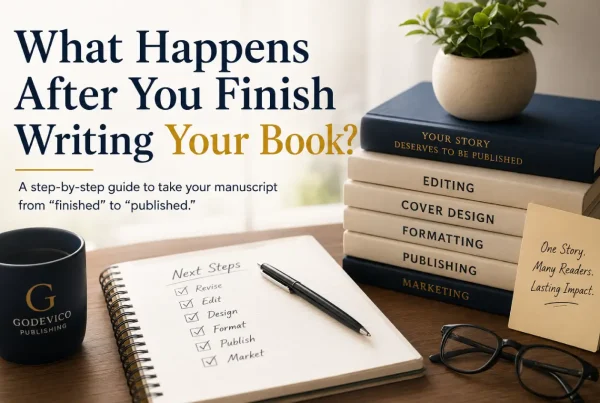
For a deeper explanation of the publishing process, read our guide on [what happens after you finish writing your book].
Mistake 3: Choosing the Wrong Book Cover
A book cover should not be chosen only because the author personally likes it.
The cover is created for the reader.
Its job is to communicate the genre, tone, and intended audience within a few seconds. A beautiful design can still be the wrong design if it sends the wrong message.
For example:
- A thriller should not look like a light romance.
- A children’s book should not look like a corporate guide.
- A memoir should not feel like a fantasy novel.
- A business book should not look overly playful or confusing.
Before approving a cover, study professionally published books in the same genre.
Pay attention to:
- Typography
- Color combinations
- Image style
- Title placement
- Overall mood
- Use of people, objects, or symbols
- Readability at thumbnail size
The purpose is not to copy another cover. It is to understand what readers already associate with your category.
A strong cover should feel original while still fitting naturally within its market.
Read our guide on [how to choose the right book cover for your genre] before approving your final design.
Mistake 4: Ignoring Professional Book Formatting
A book can have excellent writing and an attractive cover but still feel unprofessional when opened.
Interior formatting controls how the text appears on the page. It affects readability, pacing, and the overall impression of quality.
Poor formatting may include:
- Inconsistent fonts
- Incorrect margins
- Crowded pages
- Uneven spacing
- Weak chapter openings
- Incorrect page numbering
- Awkward page breaks
- Misaligned headings
- Blurry or misplaced images
Print books and ebooks require different preparation.
Print Formatting
A print edition must account for:
- Trim size
- Gutter spacing
- Margins
- Page numbering
- Headers and footers
- Chapter openings
- Paragraph styling
- Front and back matter
- Image placement
Ebook Formatting
An ebook must work properly across different devices and screen sizes.
It may require:
- Reflowable text
- A clickable table of contents
- Functional chapter navigation
- Consistent paragraph styling
- Properly sized images
- Device compatibility testing
Uploading the same file for paperback, hardcover, and ebook can create technical problems.
Each format should be prepared and reviewed separately.
Ignoring formatting is another common book publishing mistake that can make an otherwise professional manuscript look unfinished.
Mistake 5: Publishing Without Knowing the Target Reader
Many new authors say their book is “for everyone.”
In practice, that usually means the target audience has not been clearly identified.
A book designed for everyone is difficult to position, describe, and market. The message becomes too broad, and readers may not immediately understand whether the book is meant for them.
Before publishing, consider:
- The reader’s age
- Their interests
- Their reading habits
- The genres they already enjoy
- The problems they want to solve
- The emotions they want to experience
- The authors or books they may already follow
A young-adult fantasy novel should be positioned differently from adult epic fantasy.
A memoir written to support people dealing with grief should be presented differently from a general life story.
Knowing the target reader affects:
- Cover design
- Book description
- Categories
- Keywords
- Pricing
- Advertising
- Social-media content
- Review outreach
- Distribution strategy
You are not excluding other readers by defining an audience. You are simply identifying the people most likely to connect with the book.
Failing to identify the audience is one of the most common mistakes new authors make because it weakens nearly every marketing decision that follows.
Mistake 6: Starting Book Marketing Too Late
Many authors believe marketing begins after the book is published.
By then, they may already be behind.
Publishing makes a book available. Marketing helps readers discover it.
The audience-building process should begin before launch, even if the author starts small.
Before publication, consider preparing:
- An author website or landing page
- A professional author biography
- Social-media profiles
- An email signup form
- Advance reader copies
- A list of reviewers or bloggers
- Promotional graphics
- Short excerpts
- Behind-the-scenes content
- A launch schedule
Authors can begin sharing:
- Why they wrote the book
- What inspired the story
- A meaningful quotation
- Research behind the manuscript
- Cover-development updates
- Lessons learned during writing
- Short readings or excerpts
Readers are more likely to support a book when they already feel connected to the author or the story.
Waiting until launch day is one of the most avoidable mistakes first-time authors make before publishing. Even a simple pre-launch plan can create stronger early momentum.
You may also find our article on [how to write a book description that makes readers want to buy] helpful when preparing your launch materials.
Mistake 7: Choosing Publishing Services Without Reading the Details
Publishing terminology can be confusing, especially for a first-time author.
A service package may sound impressive while leaving important details unclear.
Before hiring an editor, designer, publishing company, or marketing team, ask exactly what is included.
Important questions include:
- Who owns the manuscript?
- Who owns the final cover and formatted files?
- Does the author keep the royalties?
- Which publishing platforms are included?
- Will the accounts be created in the author’s name?
- What type of editing is included?
- How many cover concepts are provided?
- How many revisions are allowed?
- Is proofreading included after formatting?
- Are printed copies included?
- Is marketing support clearly explained?
- Are there additional or recurring charges?
- What happens if the author decides to cancel?
Be cautious with vague promises.
No honest publishing company can guarantee that a book will become a bestseller, generate a specific amount of income, or receive a fixed number of reviews.
A trustworthy publishing provider should clearly explain:
- The services
- The costs
- The timeline
- The deliverables
- The author’s rights
- The royalty arrangement
- The cancellation terms
Authors should never feel pressured to sign an agreement they do not fully understand.
Choosing services without reviewing the details is one of the most expensive mistakes first-time authors make before publishing.
Before choosing a route, compare your options in our guide to [self-publishing vs. traditional publishing].
More Mistakes First-Time Authors Make Before Publishing
The seven mistakes above are among the most common, but authors should also avoid:
- Choosing a title without researching similar books
- Writing a weak or overly long description
- Selecting random keywords and categories
- Setting the price without studying comparable titles
- Publishing without reviewing a proof copy
- Using low-quality stock images
- Paying for fake reviews
- Expecting immediate sales without ongoing promotion
- Trying to manage every professional task alone
Most publishing problems are easier to correct before the book becomes publicly available.
Once the book is released, errors may affect reviews, sales, credibility, and reader trust.
How First-Time Authors Can Prepare Before Publishing
Before selecting a release date, complete a final readiness check.
Manuscript Readiness
- Has the manuscript been revised from beginning to end?
- Has someone outside your immediate circle reviewed it?
- Has it received the appropriate level of editing?
- Has the final version been proofread?
Cover and Formatting
- Does the cover clearly fit the genre?
- Is the title readable as a small thumbnail?
- Has the print edition been professionally formatted?
- Has the ebook been prepared separately?
- Have you reviewed a digital or physical proof?
Publishing Setup
- Are the title and subtitle final?
- Is the author name displayed consistently?
- Is the book description ready?
- Have the categories and keywords been researched?
- Are the price and distribution plan clear?
- Do you understand your ISBN options?
For reliable ISBN information, authors can review guidance from Bowker, the official ISBN agency in the United States.
Marketing Preparation
- Do you know the target reader?
- Is there a launch plan?
- Have advance reader copies been prepared?
- Is the author platform ready?
- Do you have content planned for before and after release?
Authors preparing to publish through Amazon should also review the current submission and formatting requirements provided by Amazon Kindle Direct Publishing.
If several of these areas remain unclear, the book may need more preparation before publication.
That is not a failure.
It is part of creating a professional product.
Avoiding First-Time Author Mistakes
Finishing a manuscript is a major accomplishment, but publication is where a private writing project becomes a public product.
Readers will not see every late night, revision, or difficult decision behind the book.
They will see:
- The cover
- The description
- The formatting
- The quality of the writing
- The overall reading experience
That is why the final stage deserves just as much care as the writing itself.
The goal should not simply be to publish quickly.
The goal should be to publish a book you are proud to place in front of readers.
At Godevico Publishing, we help authors avoid the most common mistakes first-time authors make before publishing by creating a clear, professional path from manuscript to market.
Depending on the project, our team can assist with:
- Manuscript evaluation
- Professional editing
- Proofreading
- Cover design
- Print and ebook formatting
- Publishing setup
- Distribution
- Metadata preparation
- Author branding
- Launch support
You have already done the difficult work of writing your book.
The next step is making sure it enters the market in the strongest possible form.
Preparing to publish your first book?
Review what your manuscript still needs before choosing a release date or uploading it to a publishing platform.